Power required vs airspeed
Electrical power for level flight. Speed is expensive: drag power grows with roughly V³.
Loaded (MTOW)Empty (after drop)
Data table
Mission energy vs cruise speed
Data table
Energy by flight phase
At the selected cruise speeds, against the battery.
Mass budget
The battery takes whatever mass is left under the MTOW cap.
Baseline design
Configuration
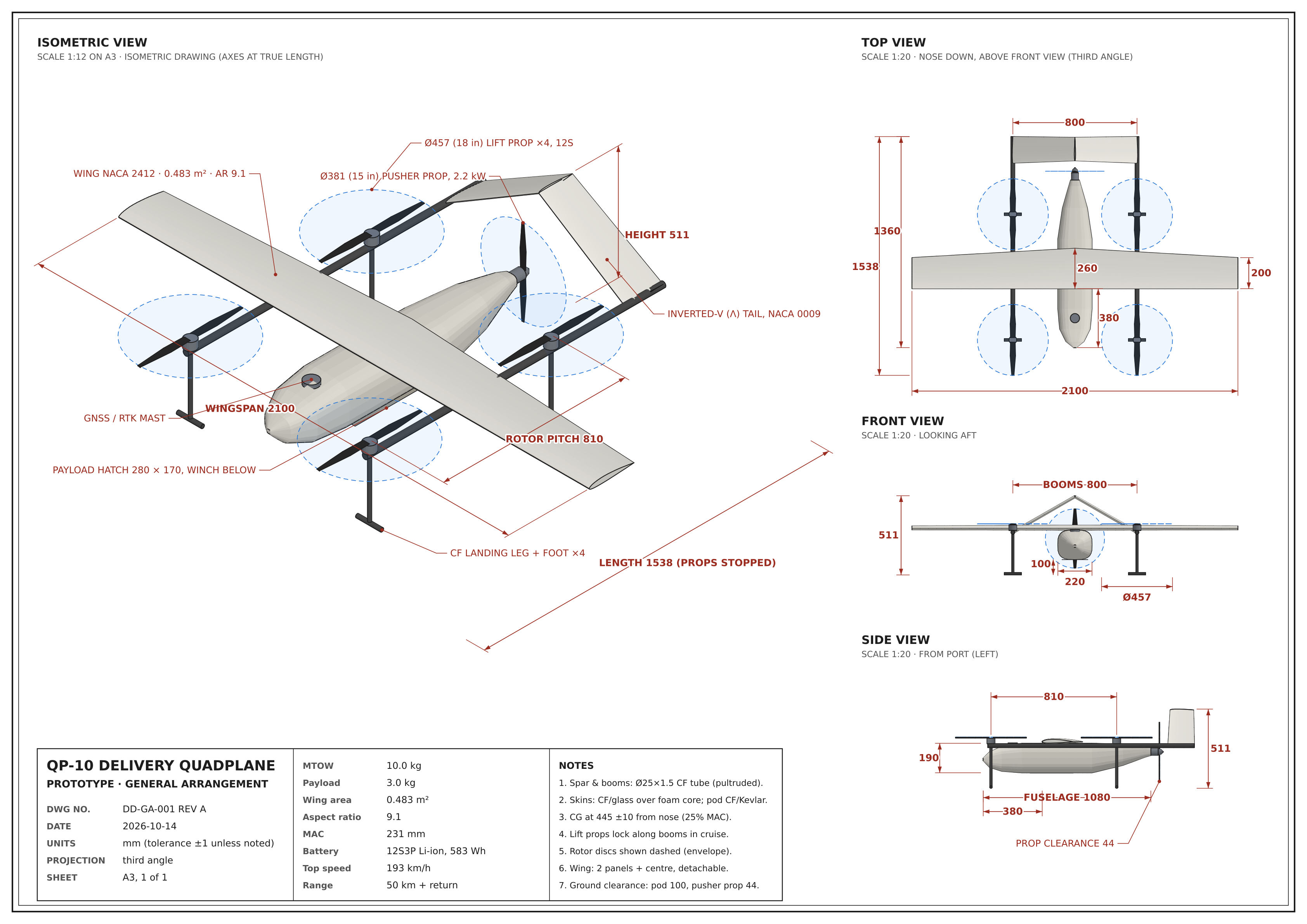
- Quadplane: 4 lift rotors on two wing booms, 1 rear pusher motor. Needs no runway or catapult, and can hover to winch the parcel down.
- High wing, 2.1 m span, 0.48 m² area, aspect ratio 9.2, laminar section (MH-32 / RG-15 class) with plain flaps.
- Inverted-V (Λ) tail joining the boom ends. Pod fuselage 1080 × 220 × 190 mm with a 280 × 170 mm payload hatch at the CG, so dropping the parcel doesn't shift balance.
- Lift rotors are 810 mm apart along the booms and the booms are 800 mm apart. Four CF landing legs sit under the motors. Overall length is 1360 mm (1538 mm with the props stopped) and height is 511 mm.
- Lift props lock in line with the booms in cruise to cut drag.
Structure
- Carbon-fiber spar tube and booms. Wing is a foam core with carbon/glass skin. Fuselage is a carbon/Kevlar shell.
- Design load factor +4/−2 g at 10 kg, with a 1.5 safety factor. Never-exceed speed 60 m/s (216 km/h).
- Wing comes apart in two halves plus booms for transport.
Propulsion
- Lift: 4 × ~500 KV, 6–7 kg-thrust motors on 18" carbon props, 12S. Thrust-to-weight about 2.4 at MTOW.
- Cruise: 2.2 kW outrunner, 15×10 folding prop. Pitch is chosen for 150+ km/h.
- Battery: 12S3P 21700 Li-ion (Molicel P45B class), 583 Wh, about 3 kg. Its 135 A rating covers hover peaks.
Avionics and payload
- Pixhawk 6X running ArduPlane QuadPlane. Dual GNSS (RTK optional), pitot airspeed, rangefinder for landing.
- 4G/LTE + 900 MHz telemetry for beyond-line-of-sight flight. Remote ID. ADS-B receiver.
- Payload: 3 kg box (~30×20×15 cm) on a 20 m tether winch with auto-release. Drops from a hover at 15–20 m.
- Failsafes: return-to-launch, quad-assist on low airspeed, ballistic parachute (~250 g option).